Counter-Strike 2 in 2026: A Data-Driven Analysis of Valve's Flagship Tactical Shooter


Counter-Strike 2 (CS2) is a free-to-play competitive first-person shooter developed by Valve, available exclusively through Steam. As of January 2026, it dominates player engagement metrics, esports viewership, and virtual economy activity, making it one of the most significant live-service games in the PC gaming market.
Player Count Analysis: DAU, MAU, and Retention Metrics
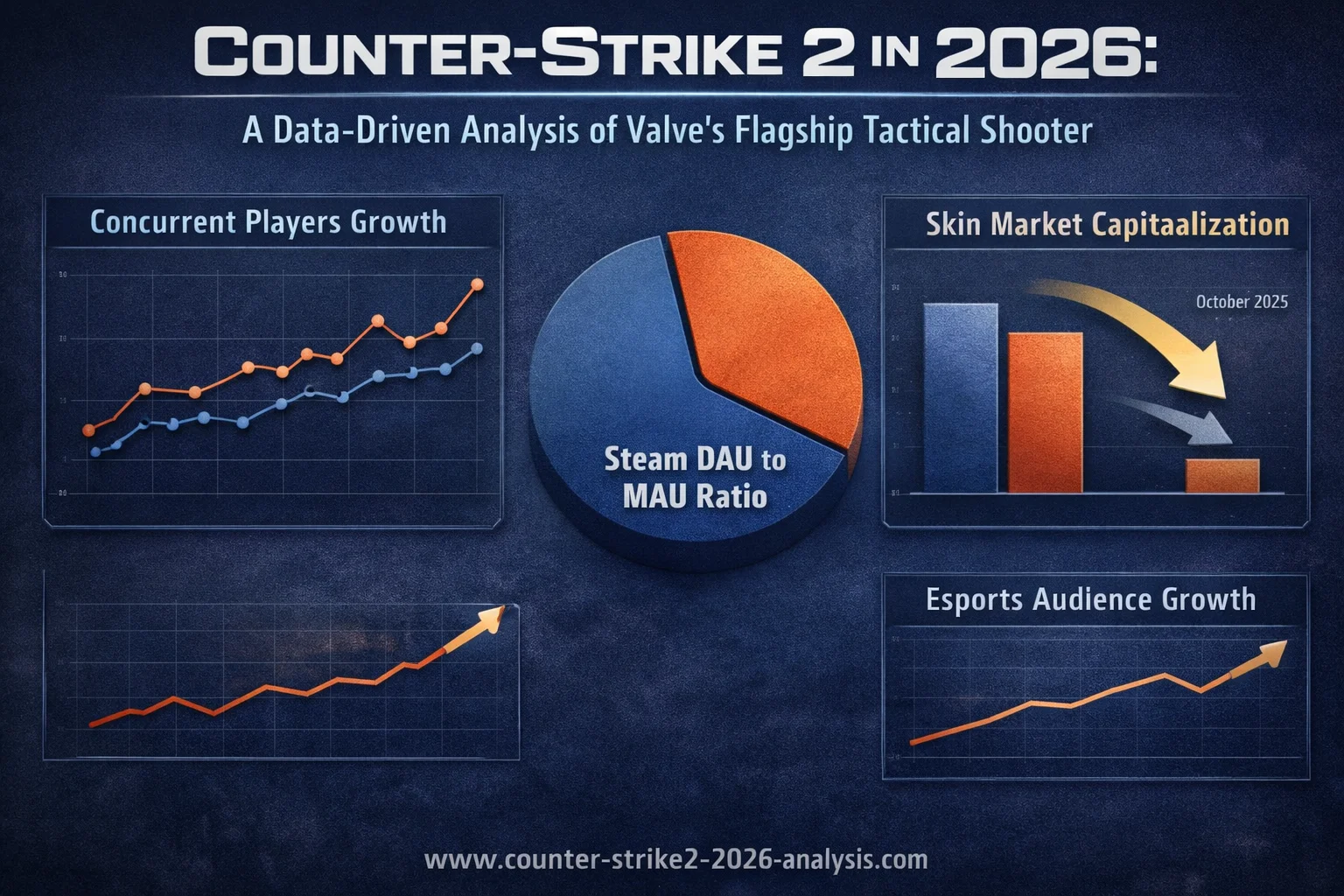
CS2 consistently registers the highest concurrent player counts on Steam, a key indicator of daily active user (DAU) strength. Steam statistics from January 2026 show CS2 leading with approximately 856,000 concurrent players at typical hours and 24-hour peaks exceeding 1.6 million. Third-party trackers report over 1.4 million unique daily players, confirming robust DAU figures.
Metric | Value (Jan 2026) | Source |
|---|---|---|
Concurrent players (typical) | ~645,000–856,000 | steamdb |
24-hour peak | ~1.6 million | |
All-time peak | 1.86 million (April 2024) |
Steam's platform-wide DAU reached 69 million in late 2025, with CS2 maintaining its position as the most-played title—a DAU-to-MAU ratio of 52.27% across Steam suggests strong daily engagement. CS2's sustained concurrency above 1.5–1.8 million during peaks implies a monthly active user (MAU) base in the tens of millions when extrapolated across 30-day cycles.
Retention drivers include the in-game economy system, which rewards tactical play and team coordination, and integration with Steam's marketplace for skin trading — both factors contributing to stable player counts across skill levels.
Gameplay Mechanics and Competitive Meta
CS2 preserves the round-based, economy-driven format that made Counter-Strike an esports cornerstone. Each match consists of short, high-stakes rounds where one death eliminates a player until the next round, emphasizing positioning, aim, and utility usage.
Weapon Meta (2025–2026)
The current weapon balance reflects Valve's incremental tuning:
AK-47: Remains the Terrorist-side staple due to one-shot headshot potential and high base damage.
M4A1-S vs. M4A4: The silenced M4A1-S is favored for accuracy, but M4A4 sees increased use for its larger magazine in clutch situations.
AWP: Central to Counter-Terrorist setups, requiring dedicated team strategies around its positioning.
Utility: Smokes, flashes, molotovs, and HE grenades remain essential for map control, with dynamic volumetric smoke grenades introduced in CS2 changing how players contest space.
Strategic Trends
Professional and ranked play in 2025–2026 emphasizes:
Default-heavy playstyles relying on individual skill and late-round decision-making.
Economy management as a differentiator—smart force buys and eco rounds shift match momentum.
Re-aggression tactics by CTs to disrupt predictable Terrorist executions.
Premier Mode and Ranking System
CS2 features two competitive frameworks: Competitive Ranks (map-specific) and Premier Mode (global rating).
Premier Mode assigns a numerical rating after 10 placement wins, functioning similarly to tournament Elo systems. Wins increase the rating; losses decrease it. The system prioritizes match outcomes over individual stats, emphasizing teamwork.
Competitive Ranks are earned per map after 10 wins, with progression influenced by win rate, kills, assists, utility usage, and MVP status.
This dual system allows players to track both overall skill (Premier) and map-specific proficiency (Competitive), feeding into global and regional leaderboards that drive engagement.
Skin Economy: Market Dynamics and the October 2025 Collapse
CS2's virtual economy — built on tradeable weapon skins, knives, and gloves—represents one of gaming's largest secondary markets. However, the October 2025 update triggered a dramatic market correction:
Pre-update capitalization: ~$6 billion.
Post-update capitalization: ~$4 billion (a 30%+ drop in under 24 hours).
Catalyst: Valve allowed players to create knives from five rare skins, flooding the market with previously scarce items. Knife prices fell from thousands of dollars to ~$50 minimums.
This shift benefited casual players seeking affordable rare items but devastated investors holding high-value collectibles. Market analysts note that 2026 demand now favors skins with clear supply limits and strong visual appeal, as buyers have become more cautious about scarcity claims.
Find out which cases actually pay out in our CS2 Case RTP guide.
Latest Updates (Late 2025 – Early 2026)
Valve's update cadence balances technical improvements, gameplay fixes, and content additions:
Update | Key Changes |
|---|---|
July 29, 2025 | AnimGraph2 animation overhaul (new first-person draw, reload, inspect animations); damage prediction fixes; shotgun reload behavior changes; map adjustments to Overpass, Train, Inferno |
October 1, 2025 | Four new maps; charms and stickers; spectator mode camera improvements; knife crafting system (market disruption) |
January 6–7, 2026 | Backend system updates—server optimization, VAC/Overwatch anti-cheat improvements, memory leak fixes, database updates |
Analysts expect late January or early February 2026 to bring public-facing content patches, including map rotations, weapon balance tweaks, and UI enhancements timed around early-year esports tournaments.
Esports Ecosystem and Future Outlook
High player engagement directly fuels CS2's esports infrastructure:
Talent pipeline: Large ranked populations support player discovery and development.
Viewership growth: Twitch and YouTube exposure from streamers and tournaments drives new player acquisition.
Investor confidence: Strong DAU/MAU metrics sustain tournament funding and league sustainability.
Steam's record-breaking concurrent user milestones in 2025–2026 underscore CS2's role as a foundational pillar for PC esports. With continued developer support, anti-cheat investment, and a stabilizing skin market, CS2 is positioned to remain the dominant tactical shooter through 2026 and beyond.