Counter-Strike 2: History, Transition from CS:GO, and the Evolution of Skins


Counter-Strike 2 (CS2) represents the most significant technological leap in the franchise's 25-year history. What began as a humble fan-made mod in 1999 has evolved into the gold standard for tactical shooters and a cornerstone of the global esports industry. Rather than reinventing the wheel, CS2 migrates the legendary 5v5 formula to the Source 2 engine, modernizing the experience while preserving the billion-dollar digital economy that defines the series.
From Fan Mod to Global Standard
The history of Counter-Strike is a timeline of community-driven innovation. Launched in 1999 by Minh "Gooseman" Le and Jess Cliffe as a mod for Half-Life, its tactical depth — focusing on round-based economies and objective-driven play—quickly eclipsed the "arena shooters" of the era.
Counter-Strike 1.0 (2000): Valve acquired the rights, launching it as a standalone title.
Counter-Strike 1.6 (2003): The "definitive" classic version that made Steam mandatory and introduced icons like the FAMAS and Galil.
Counter-Strike: Source (2004): A divisive update that introduced advanced physics but split the community between the old GoldSrc and new Source engines.
Counter-Strike: Global Offensive (2012): Initially met with skepticism, CS:GO eventually became a juggernaut, particularly after the 2013 "Arms Deal" update which introduced the first weapon skins.
Half-Life: Counter-Strike (1999–2002)
Before it was a multi-billion dollar franchise, Counter-Strike was a scrappy project by Minh "Gooseman" Le and Jess Cliffe. Using the Half-Life engine, they introduced a revolutionary concept: you didn't just spawn with a gun; you earned it.
The Beta Days: Early versions (Beta 1.0 to 7.1) saw the introduction of iconic maps like cs_mansion and de_dust.
The "Won" Era: Before Steam, players used the World Opponent Network (WON). This era was defined by "bunny hopping" and high-speed movement that felt more like an arena shooter than the tactical game we know today.
Counter-Strike 1.6 (2003–2012)
Released alongside the launch of the Steam platform, version 1.6 is often cited as the "purest" form of the game. It introduced the Riot Shield, the FAMAS, and the Galil, balancing the economy for both teams.
Legacy: Even today, 1.6 is remembered for its "wallbanging" mechanics (shooting through thick walls) and the legendary "crouch-jump" that allowed players to reach unintended vantage points.
Esports Birth: This version solidified the CS match history of legendary teams like SK Gaming and Fnatic, setting the stage for the modern Major circuit.
Counter-Strike: Condition Zero (2004)
Often the "forgotten" child of the family, Condition Zero (CZ) was Valve’s attempt to bring a single-player campaign to the franchise. While the multiplayer was essentially a polished version of 1.6 with better textures, it failed to gain a massive competitive following. However, it served as a vital testing ground for AI bot behavior that is still used in CS2 today.
Counter-Strike: Source (2004–2012)
Built on the same engine as Half-Life 2, CS: Source was meant to be the future. It introduced physics-based objects—barrels and crates would move when hit — which fundamentally changed grenade utility.
The Community Rift: The game was polarizing. Veteran players complained that the "hitboxes" were too large (making headshots too easy) and that the movement felt "slippery" compared to the crispness of 1.6.
The Pro Divide: For nearly eight years, the competitive scene was split down the middle. One half of the world played 1.6 for its "skill ceiling," while the other played Source for its modern graphics and "surfing" community.
Counter-Strike: Global Offensive (2012–2023)
CS:GO was originally intended to be a cross-platform port for consoles (PS3/Xbox 360). However, Valve quickly realized the PC community was the heart of the game.
The "Arms Deal" Pivot: In 2013, the game was struggling. The introduction of the Weapon Case changed everything. It transformed the game from a $15 purchase into a self-sustaining economy.
The Growth: CS:GO introduced the "Active Duty" map pool, professionalizing the map rotation for tournaments. By 2018, the game went Free-to-Play, and the introduction of the Danger Zone battle royale mode showed Valve’s willingness to experiment with the formula.
The Transition to CS2 (2023)
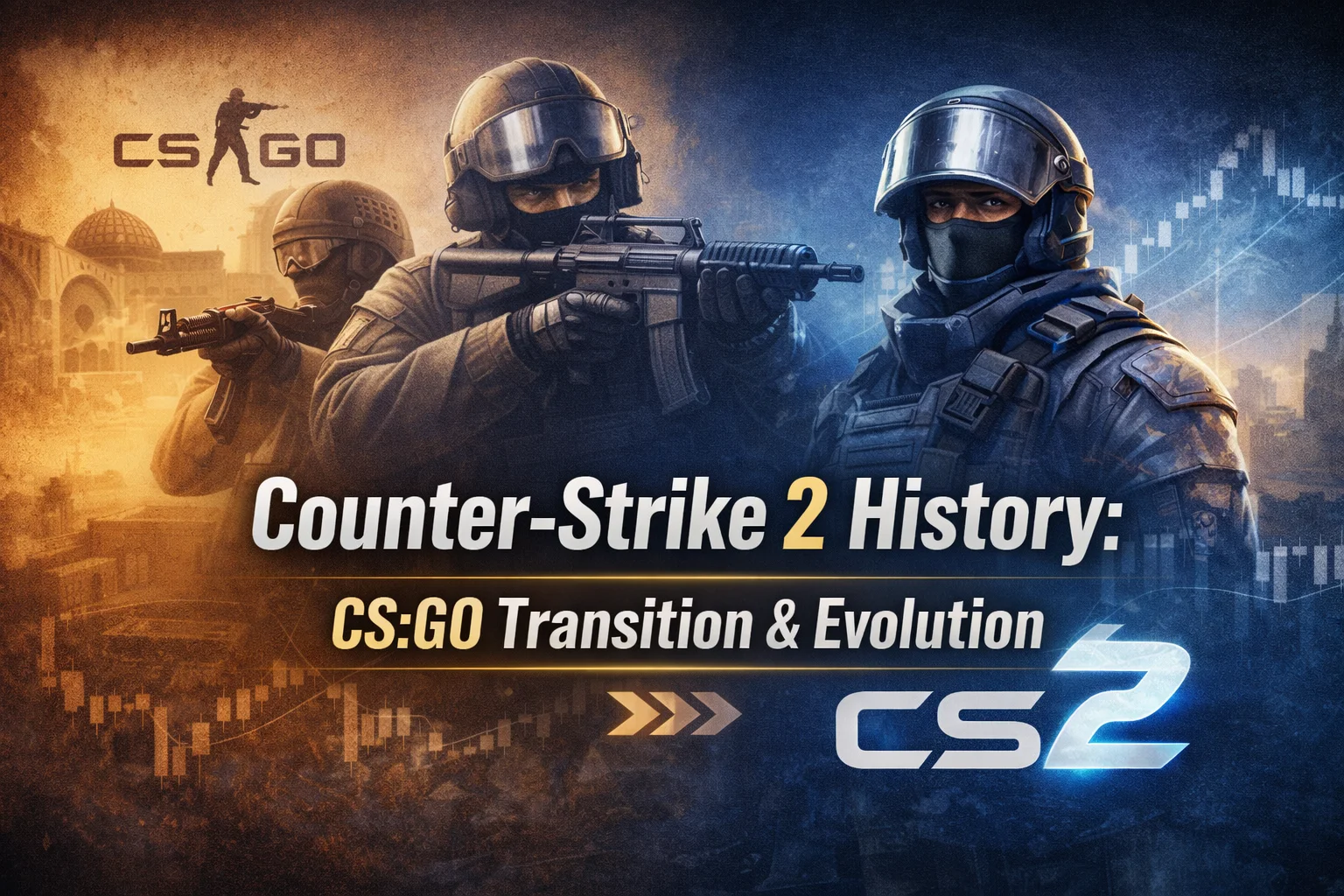
The history of Counter-Strike reached its most recent milestone with the retirement of CS:GO. On September 27, 2023, CS:GO was effectively "deleted" from Steam libraries and replaced by CS2. This was the first time in history Valve did not allow the previous version to live on alongside the new one, forcing the entire player base and the CS2 skin price history into the Source 2 era simultaneously.
Comparison of Key Historical Versions
Feature | CS 1.6 | CS: Source | CS:GO | CS2 |
Engine | GoldSrc | Source | Source (Enhanced) | Source 2 |
Key Mechanic | Extreme Wallbanging | Physics Props | Matchmaking/Skins | Volumetric Smoke |
Buy Menu | Text-based List | Radial Wheel | Radial Wheel | Loadout Grid |
Netcode | 100 Tick (Community) | 66/100 Tick | 64/128 Tick | Sub-Tick |
Counter‑Strike 2 Announcement and Release
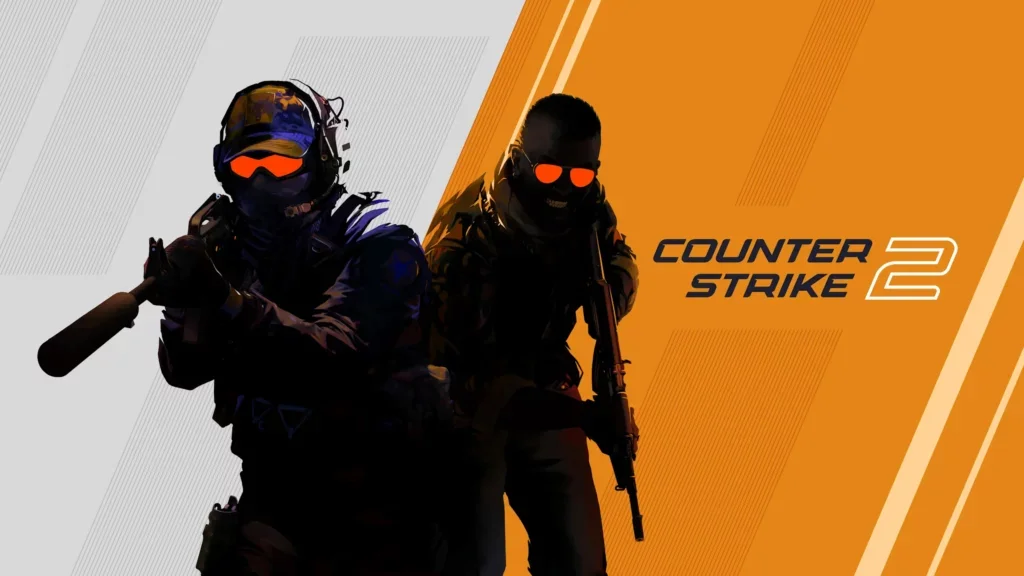
Valve officially announced Counter‑Strike 2 in March 2023, confirming the migration of CS:GO to the Source 2 engine and launching a limited test. From the outset, CS2 was positioned as a free upgrade, not a separate game: player inventories, including skins, were preserved, and CS:GO was gradually replaced by CS2 in the Steam library without maintaining parallel versions.
The full release of CS2 took place on September 27, 2023, officially replacing CS:GO on Steam. Players received:
updated graphics and lighting;
rebuilt maps using Source 2 tools;
the sub‑tick system, designed to improve action registration accuracy;
dynamic volumetric smoke grenades that react to bullets and explosions, significantly changing map control and tactical play.
Counter-Strike 2 (Source: Counter-Strike.net)
The First Months After Launch
The launch of CS2 marked a challenging transition period. At release, some familiar game modes and maps were missing, technical issues affected performance, and weapon handling felt noticeably different compared to CS:GO. These changes sparked intense community debates, with some players calling for the return of CS:GO while others viewed CS2 as a necessary technological step forward.
Valve responded with frequent updates, addressing bugs, improving network performance, refining maps, and gradually restoring familiar features and modes. At the same time, tournament organizers and professional teams transitioned competitive play to CS2, firmly establishing it as the new esports standard and effectively closing the CS:GO era at the professional level.
The Evolution of Skins: From Pixels to Assets
The "Arms Deal" update in 2013 changed gaming forever. By introducing scarcity and "float values" (the wear and tear on a skin), Valve created a secondary market.
CS2 Skin Price History and Market Shifts
The transition to CS2 caused massive volatility in the CS2 skin price history. Because the Source 2 engine handles lighting differently, certain finishes — particularly Doppler and Fade patterns — looked significantly more vibrant, causing their market value to double or triple overnight.
Skin Type | CS:GO Appearance | CS2 Appearance (Source 2) | Market Impact |
Gold/Metallic | Matte, yellow-ish | High-reflectivity, realistic gold | Massive Price Increase |
Doppler Knives | Dark, subtle colors | "Gem" like, neon glow | Extreme Volatility |
Graphic Skins | Flat textures | Enhanced 3D depth | Stable/Slight Increase |
In October 2025, a landmark Counter-Strike 2 update changed Trade Up Contracts, allowing players to exchange 5 Covert items for a guaranteed Knife or Gloves. This sent the price of "Pink" and "Red" grade skins skyrocketing, as they became the "fuel" for high-tier gambling and trading.
Learn the exact strategies to flip the most profitable CS2 skins in our guide.
The Great Market Rebalance: The 2025/2026 "Trade Up" Deep Dive
In late 2025, Valve released what appeared to be a standard technical patch. However, tucked away in the notes was a change that would trigger the largest economic shift in the history of Counter-Strike: the expansion of Trade Up Contracts to include "Gold" items (Knives and Gloves).
Historically, knives could only be obtained through the luck of a crate opening. This update fundamentally changed the "rariety-to-value" ratio, turning high-tier weapon skins into "crafting fuel."
Avoid the scams. Read our verified guide to the best CS2 case opening sites.
Are My CS:GO Skins Safe in Counter‑Strike 2?
For many players, the biggest question during the CS2 launch was not about tick rate or maps, but about years of investment into CS:GO skins. In practice, all player inventories were fully preserved:
skins remain tied to the Steam account, not to a specific game build;
CS:GO skins are visible and usable in CS2;
Valve consistently emphasized that CS2 is an update layered on top of CS:GO, not a reset of player collections.
This approach protected the value of inventories for millions of players who had invested time and money into the CS2/CS:GO skin economy. However, the security of skins depends not only on Valve but also on player behavior. The most common risks are still phishing websites, fake Steam login pages, unverified third‑party services, and careless trade offers. Major updates and market shifts can affect skin prices, but they do not remove items from player accounts — financial risk is tied to market volatility and trading activity, not to developers deleting skins.
How Did CS2 Affect Skin Gambling?
The transition from CS:GO to CS2 did not eliminate skin gambling. Platforms that previously supported CS:GO skins adapted to CS2 items using the same Steam infrastructure and third‑party APIs. As long as skins remained transferable and liquid, most services simply rebranded or expanded support for CS2 without changing their underlying business models.
At the same time, market volatility became more visible. Sharp price fluctuations showed that CS2 skin gambling and trading carry dual risks: players may lose wagers while also facing depreciation of the underlying digital assets. In the CS2 era, participation in skin gambling requires a more cautious and informed approach — checking platform legality, understanding licensing frameworks, assessing provider transparency, and recognizing that even high‑value inventories do not guarantee long‑term price stability.
Nothing in this article should be considered financial advice. CS2 skins are volatile digital items, and you should never risk more than you are prepared to lose.
Counter‑Strike 2 as an Evolutionary Step
From a franchise perspective, Counter‑Strike 2 represents evolution rather than disruption. The game retains the tactical shooter framework built on round‑based economics and team coordination, while leveraging modern rendering, networking, and engine technology.
By inheriting the esports ecosystem, competitive structure, and skin‑based economy of CS:GO, CS2 shows how a long‑standing competitive formula can adapt to new technical and market conditions without losing its identity. For a deeper look at how this evolution translates into real‑world numbers — player counts, engagement, esports viewership, and market metrics — see our follow‑up article Counter‑Strike 2 in 2026.
Frequently Asked Questions
Will CS:GO skins work in Counter-Strike 2?
Yes. Skins are linked to your Steam account, and CS:GO items remain usable and visible in CS2.
Can I lose skins because of CS2 updates?
Updates and market changes can impact prices, but they do not delete items from your inventory; losses usually come from scams or bad trades.
Is CS2 skin gambling legal and safe?
CS2 skin gambling operates in a legal grey area and is not fully safe. Legality depends on your country, and most platforms are unregulated. Risks include scams, account theft, sudden site closures, and volatile skin prices. It should be treated as high-risk entertainment, not a reliable way to make money.